I work extensively with Nagas in my own practice but rarely offer their services to clients. If you want to know why, here is a great video from Tsem Rinpoche about working with the Nagas.
Basically, they can be persnickety bastards and if it is one thing that clients love it is not following instructions.

Wednesday, August 18, 2010

Kiyosaki
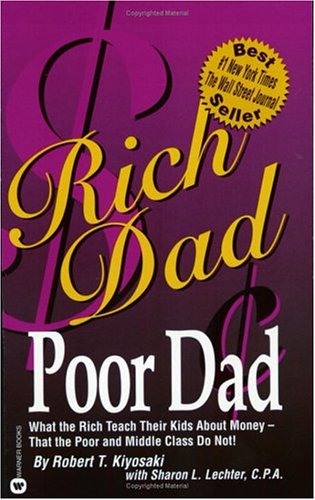
Kiyosaki is the author of Rich Dad Poor Dad as well as many other books. I have only read RDPD and Cashflow Quadrant. Where Tim Ferris provides a lot of detailed information on specific steps, Kiyosaki is useful for developing a healthy philosophy about wealth. He is a big picture guy.
The whole gist of his message is this: Rich people do not primarily earn money from paychecks. They earn it from income generating Assets. These might be businesses that you own but do not work at, intellectual property that generates residuals, properties that you own and rent out, investments that generate dividends etc. The secondary message is that you need to be financially literate. You do not need to be an accountant, but if you do not know how to read a balance steet, income statement, or investment prospectus than you lack the tools to live in the real world.
The reason that I like Kiyosaki is that he made me realize that his strategy was exactly my Grandfathers strategy for building wealth. My father on the other hand did not follow this strategy and treated money how most people do. Today my Grandmother lives in her home off the interest from her assets. My father is over 60 and is never going to be able to retire on anything other than Social Security (which he is wise enough to realize might go further if he moves to Panama - so even my Dad gets the concept of geo-arbitrage).
Kiyosaki's books really helped me think about money is a positive way and whereas Tim provided the short term goals, Kiyosaki got me thinking in terms of the overall plan.
That said, even I have some reservations about some of his points. The difference between me and a lot of his detractors is that I do not expect to love something completely or hate something completely. If I say I like someone or something that does not mean I absolutely endorse everything about him. If I say I dislike something that doesnt mean I hate everything about it. This should be obvious, but it isn't - especially in the magic/pagan community. If I say something nice about Crowley's incorporation of Yoga, they assume that I am a die hard Thelemite. If I say that I do not think of Crowley as a prophet they assume that I hate the man and everything he did. Its called Nuance people, go out and get yourselves some.
Anyway, Kiyosaki does make some points that don't sit well with people. Among them:
- Your House is not an Asset. This sets a lot of people off because they consider their house their main, and sometimes only, asset. Technically it is an asset. Kiyosaki however defines an asset as something that has a positive cashflow - in this case your house is a liability. Its a liability because you are dumping money into it for upkeep, because you are paying more in interest over 30 years than you are for the house itself, and because even if you pay it off, you still pay hefty taxes on it. Think you own the house when you pay it off? Try not paying the property tax. Someone will sweep in and wind up owning your house for a fraction of what its worth just because they could afford to buy the tax lien.
The problem is that a lot of people seem to say he is telling people not to buy a home! This is not true at all. He is telling people not to rest on your laurels and think that your house is the key to building wealth or that it qualifies as an income generating asset.
- He is not a big fan of savings accounts. He points out that if you just have savings sitting in an account or a CD that you are actually loosing money because of inflation. Whatever interest rate you are getting is not going to keep up with the cost of living.
Again, people mistake this message as him telling people not to save. Not true. He specifically says that you should have 6 months to a year worth of living expenses in a savings account for emergencies. What he says is that beyond that you will get a better yield by investing in assets: businesses, real estate, or the market would be prime examples. All reports and statistics I have looked at back this up.
- He makes it seem like you are a sap if you have a regular job. Basically he points out that rich people do not work unless they want to. Here I actually tend to agree with the criticism. While he pays lipservice to the idea that there is nothing wrong with being an employee or being self-employed, the books do read that way, and it is a shame.
While I disagree with his attitude, and honestly I still think about going for a good safe state job every now an then, he does make some points that are hard to ignore:
1. Being employed seems like security, but it is not as secure as people pretend. If you work for someone else, you can be let go and have NO control. If you work for yourself you still may fail, but you have a lot more control over it.
2. Employees who rely upon paychecks often do not even consider other ways that money can come in. In todays economy there are very few defined benefit retirement plans out there, and even the defined contribution plans are getting worse all the time. If you have assets to retire on, than you may find yourself looking for a job at 80 years of age.
- He is more or less against diversified investments: Again, I am on the fence about this. There are a lot of people who invest with the sole intent not to lose money. This strategy is not the same strategy that you use if you are looking to make money.
The problem here is that it is a lot easier to make riskier investments if you have money that you can afford to lose. If you are just starting out, this is IMO not the time to risk a lot of money. He is correct in saying that risk is necessary for reward, but doesnt do a great job at pointing out things that are just too risky.
- He seems very anti-tax. This is where I join the critics fully. I think is attutude towards taxes is repugnant. He gives a lot of good advice on how to avoid taxes through incorporation, purchasing real estate that gives tax breaks, etc. That is all fine, but it comes with an anti-tax message this is just foul
All that said, I have gotten a lot out of his books and make them work for me in tangible ways.
Monday, August 16, 2010
Tim Ferris and the Four Hour Work Week

By pure coincidence this week I bumped into criticisms of two authors that have really helped me out in my life: Tim Ferris and Robert Kiyosaki. More importantly, these are two people that I list as recomended reading to Strategic Sorcery students as purveyors of ideas that are easily combined with magical methods. In this post I will talk about Tim Ferris. I'll talk about Kiyosaki in a later post.
For those that do not know, Tim is the author of The Four Hour Work Week and the blog of the same name. Though I had read books on productivity and business before, they mostly all dealt in generalities and vague notions. Lots of "You CAN DO IT!" and not a lot of "Here is exactly how". 4HWW was different. Tim is very specific about how to accomplish anything that he puts out there. As I see it there are three aspects of the book: Business, Time Management, and what we will here call Cheats.
It is the business end where I think that the book really stands out. Instead of just assuming that you had a product in mind, Tim went through steps about how to come up with products, why you might not want to deal with a product that did have in mind, and how to run a business without a product of your own. By the end of the first "Income Autopilot" chapter I had a list on a napkin of 9 different business projects. Among them was the Strategic Sorcery Course. In addition to that, I have used information from the book to get one friend set up with Guthy Renker to market a product she invented, and helped another friend start a website drop shipping a product that he discovered while traveling.
In addition to this, the book has a lot about time management. Maybe I was not well read enough before, but I had never heard of the Pareto principal before reading 4HWW. It has changed my life. Without that principal, and many other time saving tidbits that Tim throws out there (and a healthy dose of David Allen as well), I would not be able to raise twins, run a course, write books, and serve clients. It just would be impossible.
The last aspect of the book, what I call the cheats, are basically strategies that exploit the rules of a given situation and turn them to your advantage. Want to have a little cred behind your name before you sell that DVD on Yoga for Geeks? Tim has a Four step plan to establish yourself as a credible expert. Want to work from home? Tim has a system for getting your office to let you do that (which I have seen work BTW). Want a little help managing your life and business? Tim has advice on using 3rd world personal assistants. Want to boil an egg without having to work at peeling the shell? Tim has advice for that too.
I have used parts of the book myself, and I have helped other people apply parts of his advice in the course of my work.
So, now let me address the criticism from the blogs. Specifically Gordon, Deb, and an older post by Penelope Trunk that I just read this week.
Gordon, has mixed feelings because he feels his advice only works well for a very specific demographic. He feels that: "There is a definite class barrier to his suggestions which doesn’t sit well with whatever is left of the socialist student in me". I have to say that I just can't see it. Is Tim from a privileged upbringing? Yes, probably, but most of the advice in the book is totally applicable to most people. Do you need to have a certain amount of success before you can afford to outsource? Yes. So that is something that you may not get to use. I haven't used that portion myself. You do not however have to be privileged to find yourself working in an office where you can leverage yourself into working from home. You do not have to be privileged to come up with a product, market it, and sell it.
In fact using todays technology, and a lot of the tech that Tim throws out, you need less money than ever to start a company and start doing business. I forget where I got the statistic from, but something like 60% of the billionaires in America have only a High School Diploma.
I can see how the socialist thinker might get upset if the idea of geo-arbitrage doesn't sit well with you because you feel that you are exploiting people in poorer countries, To that I would just say that business needs to be done using facts on the ground as they are. Also, people in Bangalore do quite well in these call center jobs. Having once lived in Nepal and paid $60 a month in rent I can tell you that a little money goes a long way, so what may seem like exploitation here in America, amounts to a pretty good living elsewhere.
Deb has no mixed feelings about Tim. She hates him. She has not been able to apply any of his teaching because she feels, like Gordon, that the book is disconnected from most people and that Tim "has *no* clue what it means to be really honestly middle class though the re-write claims to". Before I deal with her specific objections, I want to point out that I don't care whether Tim Ferris knows what it is like to be middle class as long as his tech is applicable. He also doesnt claim to know the middle class in the re-write. In fact rather than pretend he has that insight, most of that material in the re-write is stories from other people who have had success with his advice.
The aspects of the teaching that Deb had specific problems with are that she could not afford to outsource small projects. Neither can I, unless you count the graduating college student that built my website as a way to finish his required work for school and now uses it in his portfolio while looking for work. Still though, the outsourcing bit gets a lot of attention, but it is a small portion of the book. I do not expect to be able to practice every last bit of advice in a book myself, but does that mean it shouldnt be there for those than can? Including myself when I CAN afford it?
She also mentions that in her work she is paid by the piece and doesn't see how she would be able to work less. When I read the book I had a job involving installation of high end window treatments at the beach, I also could not get to work from home. I used to have an office job though, and you do not need to be privileged to get one. I worked for AIG and for Net2Phone and if I stayed in that life I could have used that info. Should that advice not be in the book because not everyone can use it?
In a way Deb is missing the whole point of the book. Even the bit about working from home for an office is actually just a tool for eventually moving yourself from being an Employee to Self-Employed to Business Owner. The difference between being self-employed and being a business owner is all about whether you actually work at the business you own. I am friends with a Fire Chief in north Jersey who owns a chain of Bagel shops. He cannot work from home as a fire chief, but he used the principals in 4HWW to open a chain of Bagel stores that will provide for him when he retires in a way that his pension alone never would. How long does he spend working for the Bagel chain? Actually, about four hours a week.
The last blogger is Penelope. I am not going to spend a lot of time on this one because honestly, while Gordon and Deb have specific criticisms of his work, Penelope seems to pretty much be trying to parlay her personal dislike for him into that kind of criticism. Do I believe that he had employees pose as reviewers and posters? Yes, seems like something he would do. Do I believe that he hornswaggled her into a one on one sit down? Yep, if that is what he thought his business required. Personally I couldn't give a shit whether I like him or not. Its the advice I care about and that has worked wonders for me.
Friday, August 13, 2010
Does it work? That should not be the main question.
My entire career in magic people have been telling me "Did it work or not? That is the main question."
When I questioned the efficacy of OTO initiations, people told me: "well they work. Something definitely happens".
When I question whether Scroodge McDuck is as effective a wealth god as Dzambhala, people told me: "but the ritual worked!"
When I question whether it is important to be so traditional that there is no room for creativity or improvisation people tell me: "but it worked"
That used to be the question for me, but I got over it.
See, the way that magic is, just about anything will "work". You can stick your thumb up your ass and dance on one foot while chanting for a result in pig latin and it will work. And yes, I know this from experience.
I assume that when just about anyone does magic, some magic happens. My questions are:
1. Did it meet the stated Goals?
2. How well?
3. How fast?
4. How applicable is it in most situations?
5. Can I do it anywhere?
6. Can I do it anytime?
7. Is it repeatable?
8. How strong was the result?
9. Were there any side effects?
10. Does this work for everyone or just me?
11. Do you need any particular gifts to work this?
Etc, etc.
So when people leave Chaos magic, its not because they think that Chos Magic doesnt work. Its a matter of how well it works vs other things. When people leave the OTO, its not that there is nothing happening at the initiations, its that they are not producing the results in people that is worth continuing on for, When people loosen up about tradition, its that they realize that they arent getting measurably better results using thread spun by a virgin than they were when they were using embroidery thread.
As practical magicians we need to ask ourselves tougher questions than we usually do.
When I questioned the efficacy of OTO initiations, people told me: "well they work. Something definitely happens".
When I question whether Scroodge McDuck is as effective a wealth god as Dzambhala, people told me: "but the ritual worked!"
When I question whether it is important to be so traditional that there is no room for creativity or improvisation people tell me: "but it worked"
That used to be the question for me, but I got over it.
See, the way that magic is, just about anything will "work". You can stick your thumb up your ass and dance on one foot while chanting for a result in pig latin and it will work. And yes, I know this from experience.
I assume that when just about anyone does magic, some magic happens. My questions are:
1. Did it meet the stated Goals?
2. How well?
3. How fast?
4. How applicable is it in most situations?
5. Can I do it anywhere?
6. Can I do it anytime?
7. Is it repeatable?
8. How strong was the result?
9. Were there any side effects?
10. Does this work for everyone or just me?
11. Do you need any particular gifts to work this?
Etc, etc.
So when people leave Chaos magic, its not because they think that Chos Magic doesnt work. Its a matter of how well it works vs other things. When people leave the OTO, its not that there is nothing happening at the initiations, its that they are not producing the results in people that is worth continuing on for, When people loosen up about tradition, its that they realize that they arent getting measurably better results using thread spun by a virgin than they were when they were using embroidery thread.
As practical magicians we need to ask ourselves tougher questions than we usually do.
Thursday, August 12, 2010
Isaac Bonewits has passed

I was lucky to have met him several times, and now as an occult teacher and author myself, honored to speak on a few panels along side him.
May peace be with him, and may his family be comforted during their time of mourning by the immense impact he had on our community and the art.
PS: I had to post this photo, because it is IMO one of the coolest photos ever taken of any occultist.
Wednesday, August 11, 2010
Expectation and Observation

"We have looked at people on the astral who are claiming to have these intense spiritual or mystical experiences and all that is happening is that their angel is empowering them and they are moving their energy around."
I am sure that what they are seeing IS happening. What they are watching though is a reaction to the experience, not the cause of the experience. During an intense mystical experience the subtle body and associated spiritual powers on the physical, etheric, astral, soul, and mental levels all have a reaction.
Materialists who study these phenomena will notice an increase in Alpha and Theta waves in the brain during these experiences. They will also notice blood flowing away from the parietal lobe, which determines personal boundaries, and into the frontal lobe which controls analysis. Materialists will point to these changes and say:
"Aha! See, there is nothing spiritual going on here. This is just chemistry!".
Again, these are reactions to an experience, not the experience itself, but because the materialist wants a material explanation for everything, they are cling to this as the explanation.
The problem is that when you look at porn your brain also makes changes in waves and blood flow. That doesn't mean that the porn isn't really there on your screen. It just means that your brain is reacting to seeing the porn. You filthy deviants...
It is the same case for the energy/astral worker. He is trained to work in a certain strata and when he sees something happen on that level, he can be quick to dismiss any dimension of that experience that does not fit his view.
So, the lesson I want to get accross here is to always be open to the idea that you are not seeing everything. If you think you have the whole thing mapped out, you are probably wrong. Try to keep in mind that there is not only more than you know, but more than you can know.
Also, try to remember to delete your internet history every now and then...
Monday, August 9, 2010
Customization and Creativity

Now if I let this post stand alone one might think that I am a hard core traditionalist and believe that everyone must follow instructions to the letter. I do not mean to give the impression that all you need to do are follow pre-set steps all the way to enlightenment. Nor do I mean to say that the individual is un-important in the operation of magic. Nothing could be further from the truth.
In fact, as I recently pointed out in a lesson on working with the Spirits in grimoires, when it comes to the "do it exactly as it says in the book" approach vs the "lets make it better, stronger, faster, we have the technology" approach I lean much further towards the view of the hacker than the traditionalist. In the end I am much more interested in being, and teaching people to become, someone who can author and effective grimoire not just follow instructions in one.
When I would run into people in the Vajrayana who would argue about how one teachers approach was universally better than another, I would love to point out that the only thing that the 84 Mahasiddhas have in common is that none of them attained enlightenment in the same way. They were extremely dynamic and Tantra manifested differently in all their lives. Some became wandering Yogi's, some remained Kings, some worked simple jobs in silence. Some attained through sex, some through mantra, some through contemplation.
In almost all cases in all traditions throughout the world advanced practitioners seem not content to simply follow a path and leave it unchanged, but feel compelled to contribute something new. New versions of old rituals and prayers or entirely new practices that originate from them, it is clear that Creativity is part of the great work. My own course and teachings are an attempt at this.
Once you learn principals of magic, the specific methods can be customized and changed. Just realize that when you are changing it, you are making something new. If you do a prayer to Sophia over your Miraculous Medal, you are no longer doing the Miraculous Medal ritual. If you use your Phurba as an Athame, you are not in any way being a Phurba practitioner. What you do may be awesome, but if you go far enough off the map, it is no longer tapping into the same source as the original.
So, if I accept that creativity and customization are part of the work, why all the bitching about letting a path inform your personality rather than the other way around?
Because in all arts, not just magic, the people who successfully break the mold and create new things, know what it is that they are breaking and bending. The beats broke all the rules of literature and produced masterpieces (well, some of them did). The wanna-be beats that followed didn't even know the rules well enough to break them and ended up producing shit.
So is it necessary to be advanced for creativity and customization to play a role in spirituality and magic? No. Some people will feel those urges right at the start. It is however necessary to learn what it is you are changing and to be honest in your assessment of your changes. Some people claim that any ritual that you write will be better than something someone else wrote. Same with tools: anything that you make will be better than anything that you buy. With all due respect, I have found this to be completely false. The power of DIY is another over-rated factor. It is quite possible to produce something slower, lamer, and weaker than what came before. It is possible to create a tool so ugly that it inspires nothing but shame. Honest assessment is the key.
This skill of honest assessment is needed right from the beginning. After all, before you can let a path challenge you, you need to pick a path to start on. If you choose one that fits your personality, has a strong internal resonance, and offers up a challenging ideal to rise to than its great. When you come accross those aspects that you have trouble with it will be worth the time to try and understand and grow through it. If after an honest assessment you think the tradition needs changing you can do that from a place of knowlege and power. You will be doing the current a service by assisting in its evolution. Any path that is not evolving is dead.
If you chose a path because it is comfortable and requires nothing of you because the essence of it is "do whatever you feel" right at the start, than you are not going to get much from it.
Subscribe to:
Posts (Atom)